By Hiba Zafar | Khusro Foundation
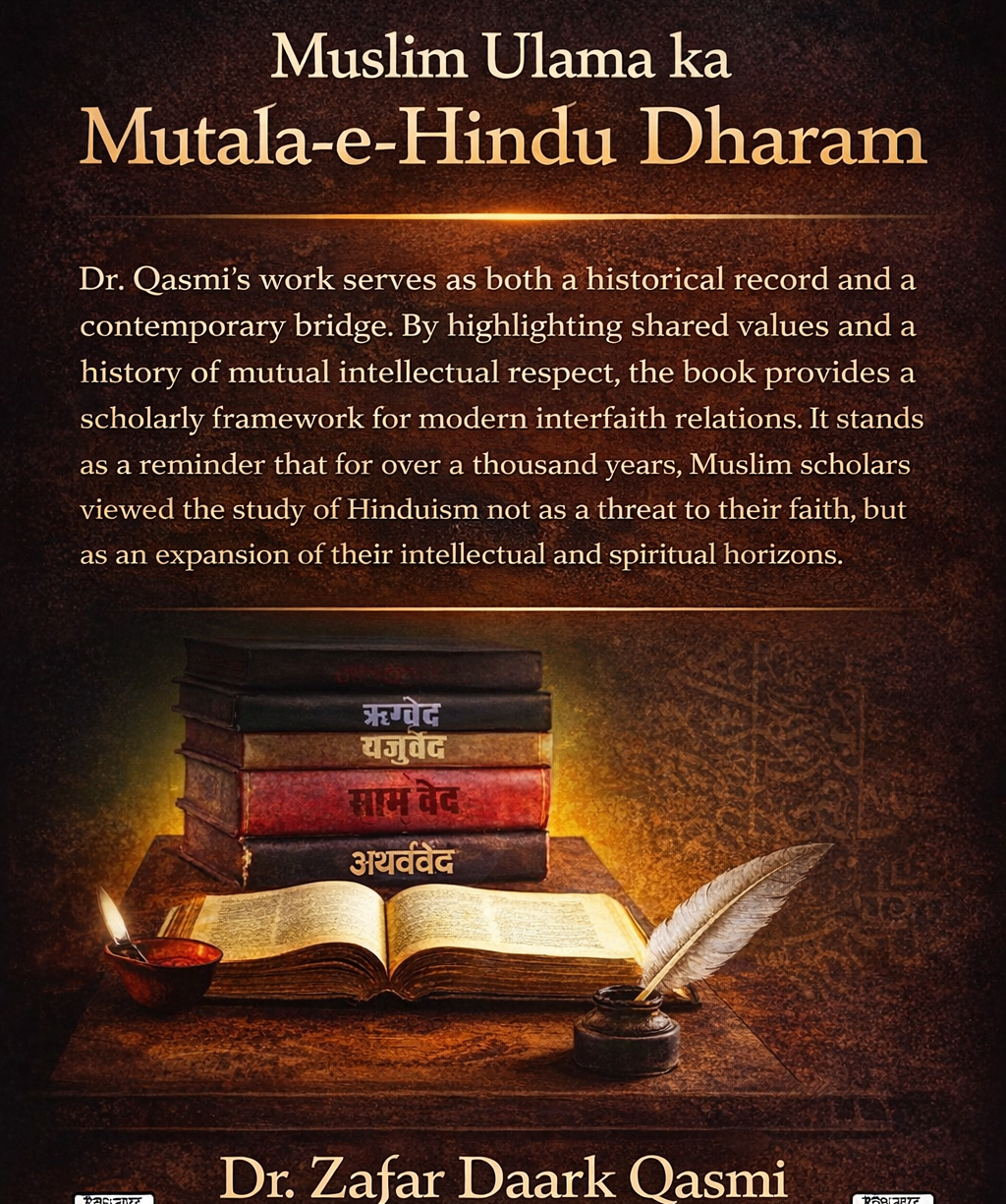
Have you ever wondered about the intellectual history that connects Islamic scholars and Hindu philosophy? "Muslim Ulama ka Mutala-e-Hindu Dharam" is an incredible Urdu book that delves deep into this fascinating, centuries-old conversation. Dr. Zafar Daark Qasmi, the author, offers an in-depth academic exploration of how Muslim theologians, historians, intellectuals, and scholars have examined, interpreted, and responded to Hinduism and its culture -particularly within the subcontinent of India.
Core Philosophy: Dialogue as a Path to Peace. The book’s preface (Pesh Lafz) sets out its main idea: communal harmony is necessary for national progress. The author argues that societies without internal harmony cannot make meaningful progress. Mutual tolerance cannot exist in a vacuum; it needs a deep, empathetic understanding of one’s neighbour, not with hostility or dismissiveness, but with genuine curiosity and scholarly rigor. Dr. Zafar Darikpositions interfaith study not as a modern secular invention, but as a religious virtue.
This shows that comparative religion is not an outside academic import into Islamic thought but has real foundations within Islamic tradition.
Historical Tradition of Muslim Scholarship. A central pillar of the work is the documentation of a "Golden Age" of comparative studies.Muslim scholars have been actively studying other religions — including Hinduism — for over a millennium. The author traces this tradition back to classical Islamic scholarship, Abu Rayhan al-Biruni, whose Tahqiq ma lil-Hind remains one of the most remarkable scholarly studies of Hinduism ever produced.
During the era of Emperor Akbar, interfaith dialogue was actively encouraged, and translation of Sanskrit texts like the Upanishads into Persian under the title “Sirr-e-Akbar” was done. Ibn Kathir, Allamah Ibn Khaldun, Ibn Athir, and many others contributed historical and comparative works that touched on Hindu civilization.
The contributions of Sir Syed Ahmad Khan, Shibli Nomani, and Maulana Inayat Rasool Chiriakoti in bridging the gap between Eastern and Western religious thought.
;
The book is organized into three thematic chapters (Abwab):
Chapter 1—This section lays the theoretical and theological mandate for studying other faiths. Quranic references to previous prophets and communities, the concept of unity of religion (Wahdat-e-Deen).
The preservation of Hinduism under Muslim rule is covered in Chapter 2. The unexpected contribution of Muslim scholars and kings to the preservation, translation, and even advancement of the Hindu religious and intellectual legacy is examined in this chapter. It includes scholarly publications by Muslims concerning Hindu civilisation from various eras of Indian history, as well as the Persian translation of the Upanishads during Akbar's rule.
Chapter 3: Common Values and Scholarly Perspectives A thorough examination of Hindu philosophy and theology, Allamah Shibli Nomani's opinions about Hindus, the similarities between Islam and Hinduism, the Hindu philosophical and theological system, important subjects in Hindu studies, and the question of whether Hindus are Ahl-e-Kitab (People of the Book).
Dr. Qasmi’s work serves as both a historical record and a contemporary bridge. He expresses the hope that this effort will be accepted in academic circles and serve as a contribution toward better understanding between communities. The book provides a scholarly framework for modern interfaith relations. Muslim scholars viewed the study of Hinduism not as a threat to their faith but as an expansion of their intellectual and spiritual horizons with serious scholarly depth and genuine curiosity.

.png)
.png)